New Rare Book Acquisition Helps Tell the History of Medical Science
Pepperdine Libraries is pleased to announce the acquisition of a salesman's copy of
The Household Physician, A Twentieth Century Medica; A Practical Description in Plain
Language of All the Diseases of Men, Women and Children (1931) by Herbert Buffum. This new Special Collections and Archives book gives students
an additional opportunity to engage directly with a unique primary source that encompasses
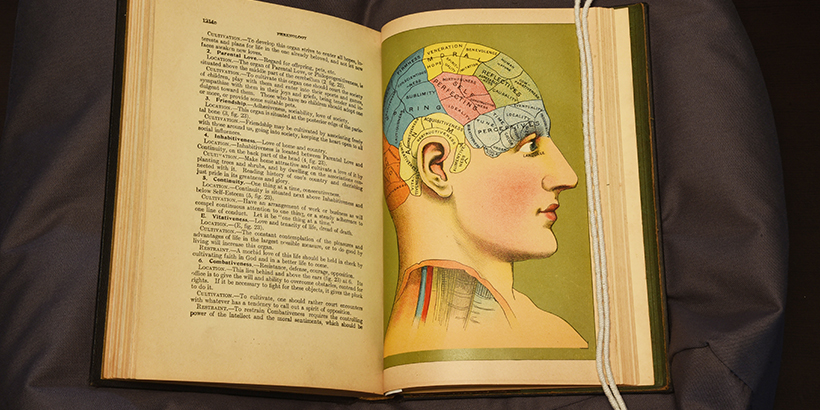
medicine, homeopathy, phrenology, and even veterinary science. Already helpful to
readers examining the pluralistic nature of American healthcare in the early twentieth
century, our edition of The Household Physician is even more valuable because it's a canvassing book.
Designed for door-to-door salesmen, these canvassing books were meant to entice potential
buyers, offering an intriguing glimpse that (hopefully) resulted in advance orders.
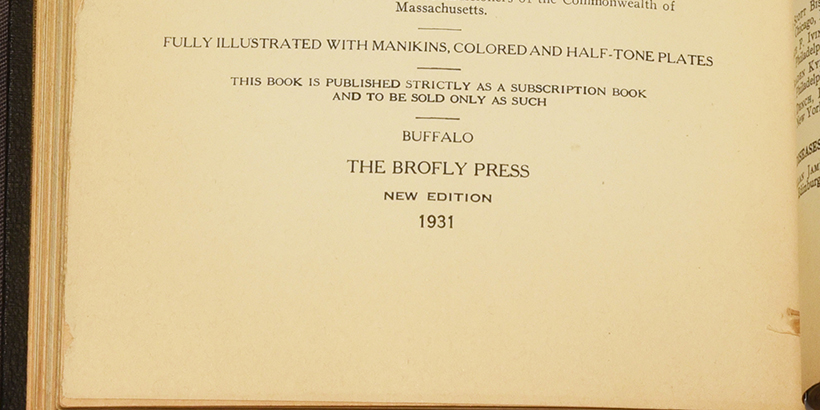
Publications such as The Household Physician were available exclusively through subscription, as noted on our volume's title page
(above). Traveling representatives collected purchase agreements, and full copies of the
book were printed and dispatched only after the initial sales round concluded. Canvassing
books survive in far smaller numbers than the works they helped promote because they
were often discarded once selling periods ended.
Because the complete edition of The Household Physician is so massive—expanding from a single 1,440-page tome in earlier printings to a two-volume
set by 1931—the publisher's sample offers just a selection of its pages bound out
of numerical order. To captivate customers, it features bold promotional headlines
such as "A Mother’s Duty," "Cure Your Cold in 48 Hours," and "Over 375 Medical Prescriptions
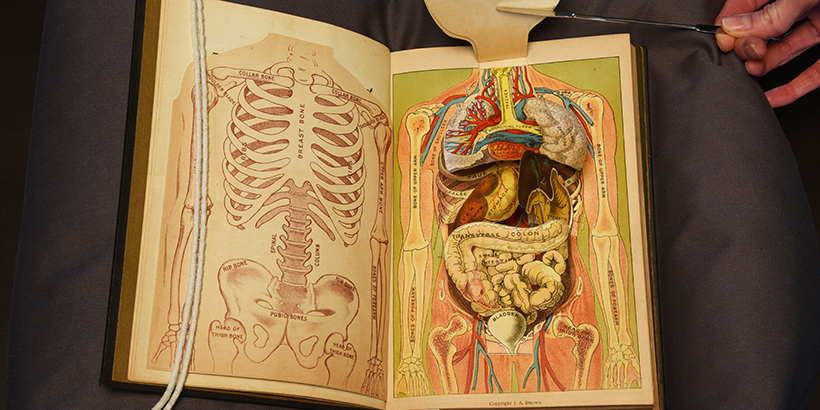
in Latin and English," as well as interactive plates with movable flaps. This design
enabled a salesman to flip back and forth between promotional leaves and eye-catching
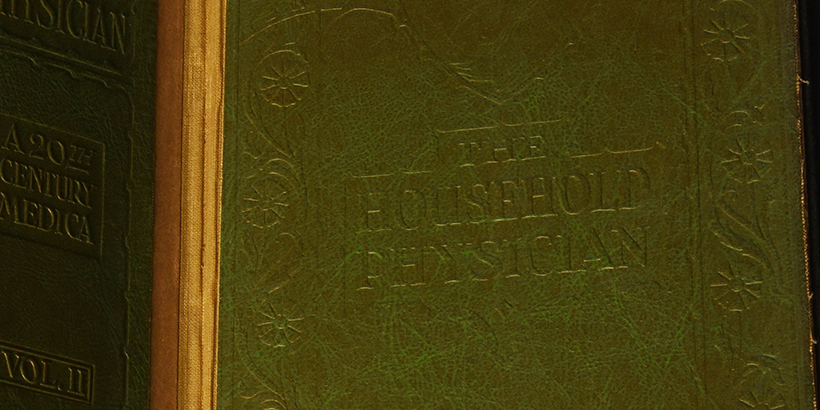
illustrations according to the needs of each sales pitch. An example of the embossed
cover, mounted within the back cover of the canvassing book, provides a final flourish
to the sample (see above).
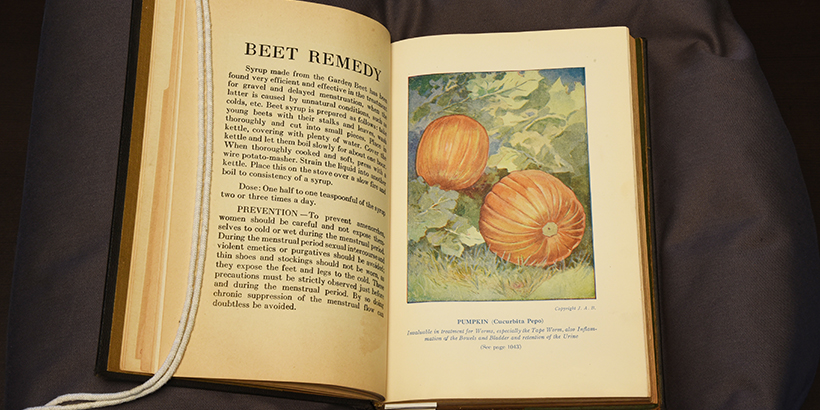
Stepping inside the sample pages offers a fascinating window into early twentieth-century
domestic healthcare. The book’s subtitle, A Twentieth Century Medica, is a direct nod to materia medica, or the knowledge of medicinal drugs obtained from plants or other natural sources.
Within its first ten pages, our canvassing book features a section on plant medicine
with guidance on foraging roots and herbs, an alphabetical glossary, and full-color
botanical plates printed on smooth, glossy paper (above).
Moving deeper into the text, modern readers will find much that feels surprisingly
relatable; a chapter titled "Diseases Peculiar to Modern Times" laments how the "press,
telegraph, telephone, and steam appliances" cause us to "rush through life," resulting
in overtaxed nervous systems and sleep deprivation. Some everyday advice, such as
startling a patient to cure their hiccups, remains unchanged. However, the book frequently
swings into remedies that have decidedly not stood the test of time. The same section
on hiccups also suggests administering "cocaine, one-eighth grain every 15 mins" as
a "simple and often efficacious remedy."
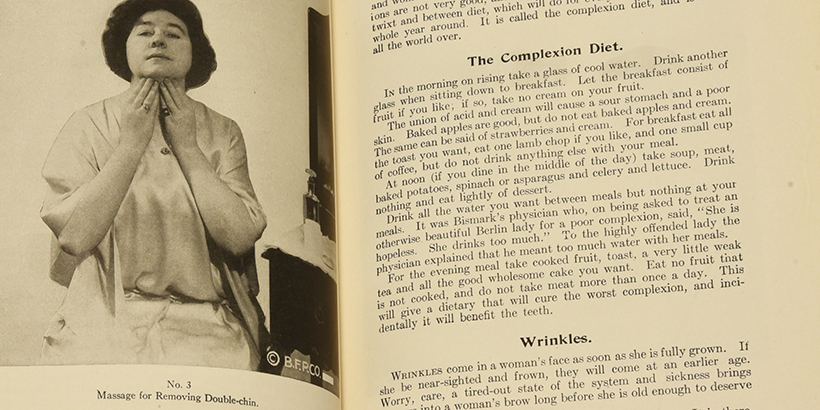
Elsewhere, a chapter titled "The Woman Beautiful" suggests a rigid "Complexion Diet"
that strictly forbids drinking water with meals. Just above that is advice to drink
a glass of milk every hour (presumably when one is not eating) to "wash all impurities
out of the system."
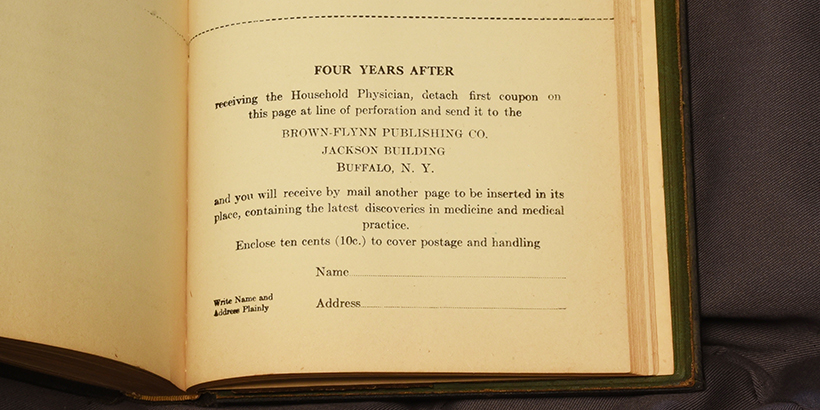
The book offers a built-in mechanism for keeping its contents current. Bound into
the volume is a series of perforated coupons (see above). For ten cents in postage and handling, a subscriber could mail one in each year
(up to four years after purchase). In return, the customer would receive a supplemental
page outlining "the latest discoveries in medicine and medical practice" that could
be added to their book.
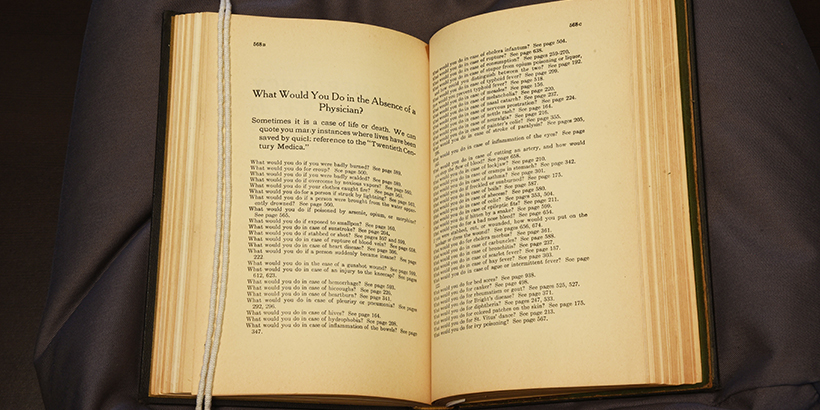
The Household Physician captures a fascinating transitional moment in American healthcare. Although the medical
field was becoming increasingly institutionalized, access to trained physicians remained
limited. Many families continued to lean on the self-reliant guidance of encyclopedic
home references—the Great Depression's onset in 1929 only increased the desire to
administer care at home. This canvassing book's hybrid nature also offers a unique
opportunity to interact with both materiality and content, inviting readers to theorize
on dual historical perspectives: the clinical aims of the medical professionals who
authored its text and the commercial motives of the publishers who engineered its
physical form for door-to-door sales. Ultimately, engaging with such a complex artifact
will promote learning about how people nearly a century ago navigated the world of
health.