Fall Programs Highlight Faith, Connect with Collections, and Stimulate Creativity
Although the fall semester isn’t over yet, the Libraries has already hosted a noteworthy
array of events that have had a meaningful impact on the University community. Several
focused on integrating faith and learning, affirming our commitment to the University’s
Christian mission. Some featured engagement with rare books and primary materials
from Special Collections and Archives, adding context to help students better understand
the lecture topic. Other programs firmly demonstrated the library’s position as a
laboratory for creativity and exploration. Below is a sampling of the many events
we’ve hosted so far.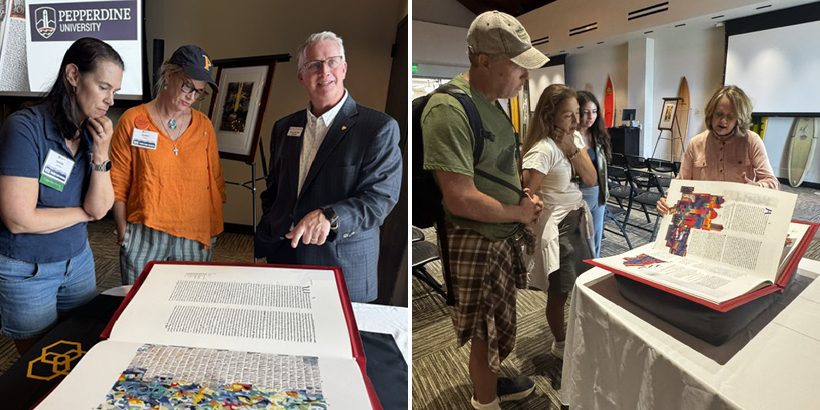
On October 10, John F. Ross, the executive director of The Saint John’s Bible Heritage
Program at Saint John’s University in Collegeville, Minnesota, gave a lecture on The
Saint John’s Bible. During the talk, the Libraries displayed four of its seven volumes:
Pentateuch, Wisdom, Gospels and Acts, and Letters and Revelation. Ross invited the
audience to closely examine the Bible illuminations and reflect on what they noticed.
For instance, a discussion about the Matthew frontispiece (Matthew 1:1-17) revealed
that the structural image of Jesus’s genealogy is both a tree of life and a menorah.
The ancestral names are listed between the innermost branches of the tree/menorah,
and between the outer branches, patterns of DNA double helices highlight the biological
reality of the incarnation. Ross also talked about Saint John's Abbey, displaying
photos of the abbey church's modernist architecture and promoting the Benedictine
abbey’s many initiatives. He shared that the monks run Liturgical Press (the abbey’s
100-year-old publishing house), a woodshop for woodworking and organ building that
uses timber from the abbey’s 2,700-acre natural arboretum, and a pottery studio. The
event was presented as part of Waves Weekend and co-organized by Seaver College’s
Parent and Family Program.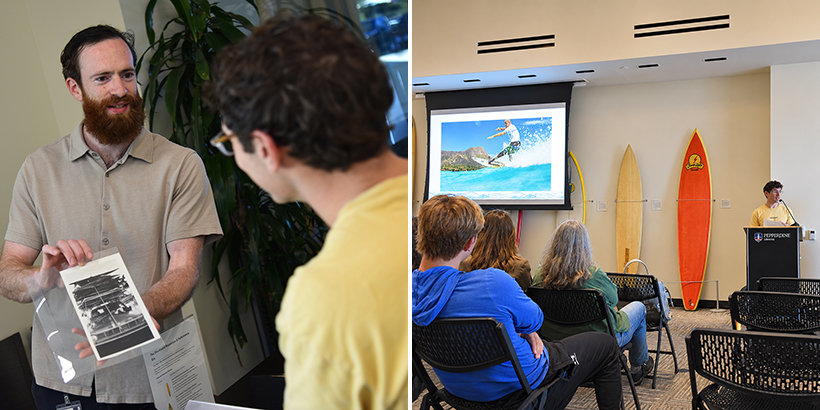
On November 4, assistant professor of English Martin Premoli gave a talk titled "Theorizing
the Adaptive Surfboard." Fittingly held in Payson Library’s Surfboard Room, Premoli
explored how surfboards are creatively adapted to make wave-riding possible for people
with physical, sensory, and developmental disabilities. He shared how adaptive surfing
challenges assumptions about the “ideal” surfing body and how changing objects and
environments can expand what bodily freedom in the water looks like. In conjunction
with the talk, Special Collections archivist Chris Miehl brought out objects from
the Malibu Historical Collection. The rare books and historic photographs helped students
learn about the history of surfing in Malibu, providing rich context for Premoli’s
talk.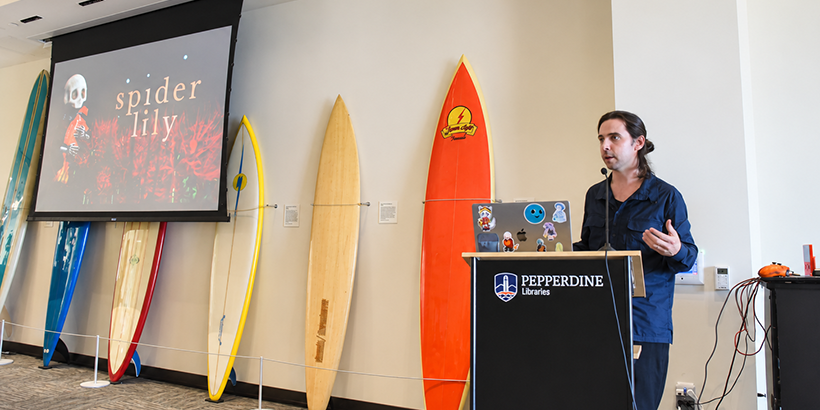
Finally, on November 10, Pepperdine Libraries partnered with the Weisman Museum of
Art and the Art and Art History Lecture Series to present a talk and demo by Falsework
Studio. Co-founders Matthew J.X. Doyle and Yuehao Jiang shared how the independent
studio helps artists develop intellectual property across multiple formats, treating
the game engine as an artistic medium. The pair explained the creation of their prototype
Spider Lily, a single-player game featuring a ‘lost soul’ and a blind fish who attempt
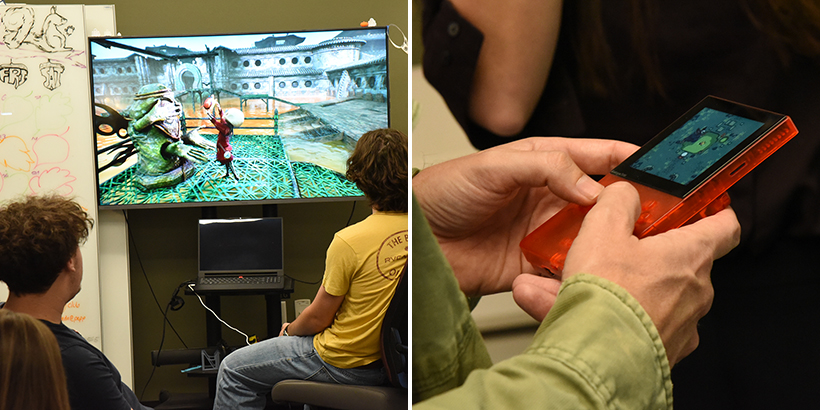
to escape death by navigating the rivers of purgatory. Following the talk, art students
and their professors walked to the Genesis Lab to test out the game. In addition to
experiencing the fantastical world in stunning three-dimensional animation on the
computer console, attendees also had the opportunity to play an 8-bit version on a
handheld game console modeled after Nintendo's iconic Game Boy. The event spotlighted
the Libraries’ Genesis Lab as a hub for emerging technologies and a place where Pepperdine
students can hone their creativity.