Library Intern Helps Catalog Libraries’ Copy of Ferdowsi’s "Shahnameh"
The Shahnameh, completed by the Persian poet Ferdowsi in early eleventh century Iran, is an epic dynastic history of Persia, chronicling the reign of 50 rulers from early civilization to the fall of the Sasanian Empire in the seventh century. Last fall semester, Pepperdine Libraries hired a graduate student intern, Samantha Stringer, to research our copy of the Shahnameh so that Special Collections and Archives could properly catalog the work. Stringer is a PhD candidate in literature at University of California, Santa Cruz, and is researching the Shahnameh for her dissertation.
Continue reading on for Stringer’s analysis of the manuscript.
* * * *
Persian served as a lingua Franca connecting a large area of Eurasia in the medieval
and early modern period. Because of this, Ferdowsi’s Shahnameh traveled widely, being copied, adapted, and translated in places as diverse as the
Kingdom of Georgia, the Mongol Khanate, and the Mughal Empire. Based on the style
of its illustrations and other codicological evidence, the Libraries' copy was likely
produced in early nineteenth-century South Asia, and perhaps particularly, in Kashmir.
Beyond the extensive influence of the Persian language, the Shahnameh’s preoccupation with the nature of just rulership has secured its consistent relevance across ten centuries and shifting political geographies. Ferdowsi not only intended his poem to memorialize the history of noblemen who traced their descent back to pre-Islamic, Sasanian Persia, but to serve as a didactic ‘mirror-for-princes,’ or an advice book for rulers and heirs. Just as often as Ferdowsi instructs through positive examples of wise and pious kings like Kay Khosrow, he warns through negative examples of arrogant and stubborn ones.
Ferdowsi frequently employs the metaphors of sight and blindness to draw a contrast between wise and arrogant rulers. In medieval Islamic thought, seeing was considered to be the first step toward leading a pious life. As the eighth-century theologian, al-Hasan al-Basri, wrote: “May God have mercy upon a man who observes (literally ‘looks’ or ‘gazes’) and reflects, who reflects and draws a lesson, who draws a lesson and perceives, who perceives and is patient.”
If sight and perception are the precursors to spiritual understanding, Kay Kavus is the Shahnameh’s quintessentially ‘blind king.’ His excessive hubris makes him easy prey for the many shape-shifting demons that inhabit Ferdowsi’s literary universe. Kay Kavus is first fooled by a demon disguised as a minstrel who arrives at his court to lure the king into a deadly mission. The king’s failure to discern the true nature of the minstrel, to see through the alluring exterior of evil, associates him unfavorably with the Shahnameh’s preeminent villain, the demon-king Zahhak. Early in Ferdowsi’s narrative, Zahhak is tricked by the devil, disguised as a cook, into murdering countless Persians to feed the snakes sprouting on his shoulders.
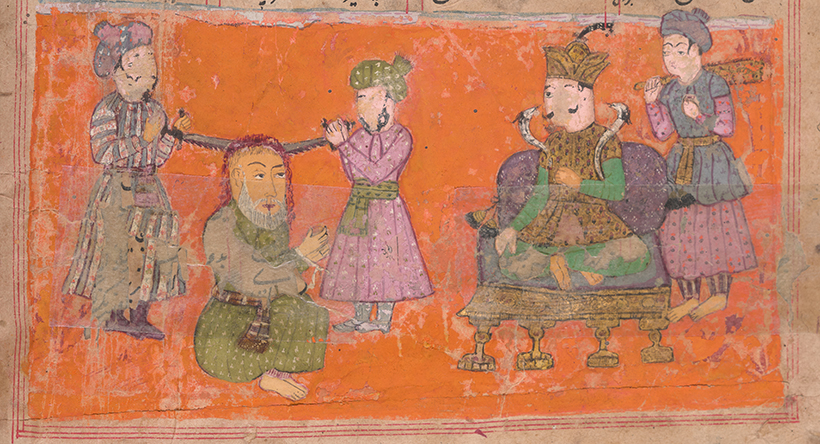 [f. 7 v – Image of Zahhak with his two snakes]
The demon-minstrel at Kay Kavus’ court lures the king by singing of the exceptional riches of Mazandaran, a land ruled by sorcerers and demons. Although Kay Kavus’ advisors recognize this as a demonically-inspired plan and attempt to dissuade him, the king marches with his army to conquer the territory. Walking directly into the demon’s trap, Kay Kavus and his men are defeated, with many slaughtered and many others, including Kay Kavus, magically blinded and imprisoned. Kay Kavus’ blindness to the limits of his own capacities, and to the visual illusions of the demons, is literalized with this punishment.
When news of Kay Kavus’ defeat reaches Persia, the warrior Rostam is sent to rescue Kavus, a mission which sets the stage for the hero’s so-called ‘Seven Labors.’ During his fourth labor, Rostam is himself confronted by a disguised demon, this time of a beautiful female wine stewardess. When Rostam employs God’s name to thank him for this perceived gift, however, the sorceress's power is destroyed and she devolves into her devilish form. Unlike Kay Kavus, Rostam’s piety and humility enables him to see through misleading appearances.
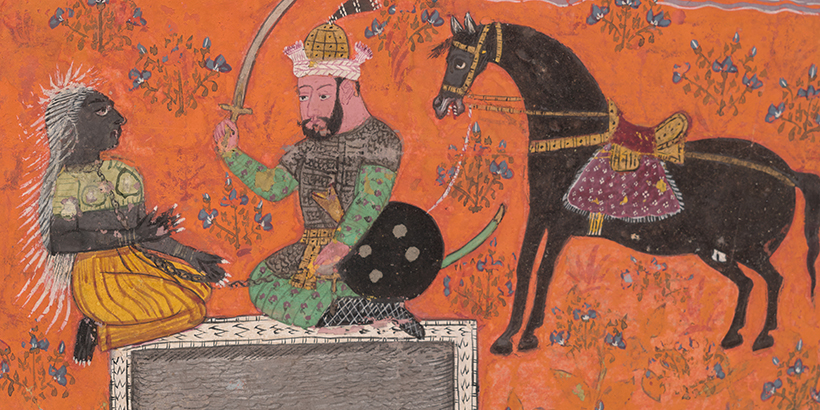 [f. 305 r Esfandyar shackles a sorceress – Mirroring Rostam’s experience, the prince
Esfandyar is here confronted by a sorceress. The manuscript depicts the sorceress
in her true form, her unkempt hair and long nails signs of the unordered nature of
evil which the hero successfully shackles.]
[f. 305 r Esfandyar shackles a sorceress – Mirroring Rostam’s experience, the prince
Esfandyar is here confronted by a sorceress. The manuscript depicts the sorceress
in her true form, her unkempt hair and long nails signs of the unordered nature of
evil which the hero successfully shackles.]
In Rostam’s final labor, the hero slays Mazanderan’s leader, the White Demon, whose blood is the antidote to Kay Kavus’ blindness. In this scene, Rostam plunges his dagger into the demon as Kay Kavus remains shackled to a tree. Kavus’ missing pupils represent his physical impairment. The composite half-human, half-animal bodies of the demons reveal their internal perversion.
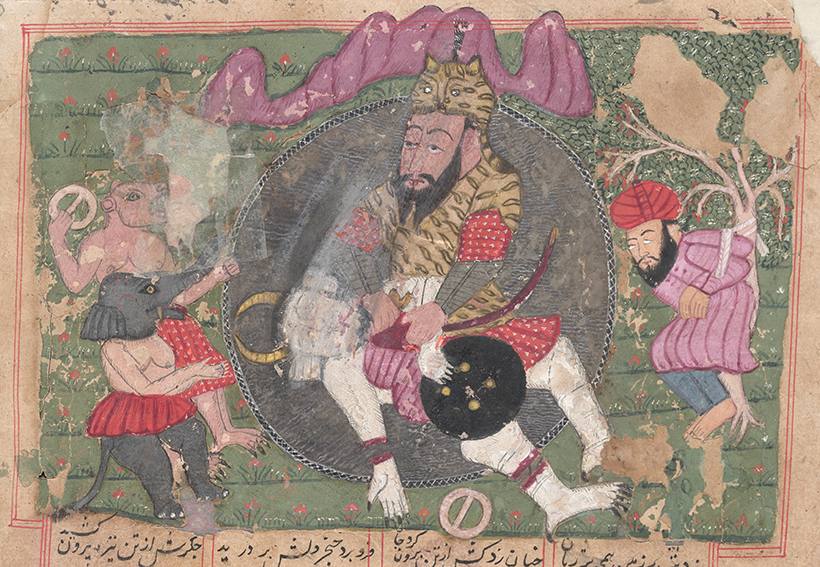 [f. 342 v Rostam battles Div Sepid]
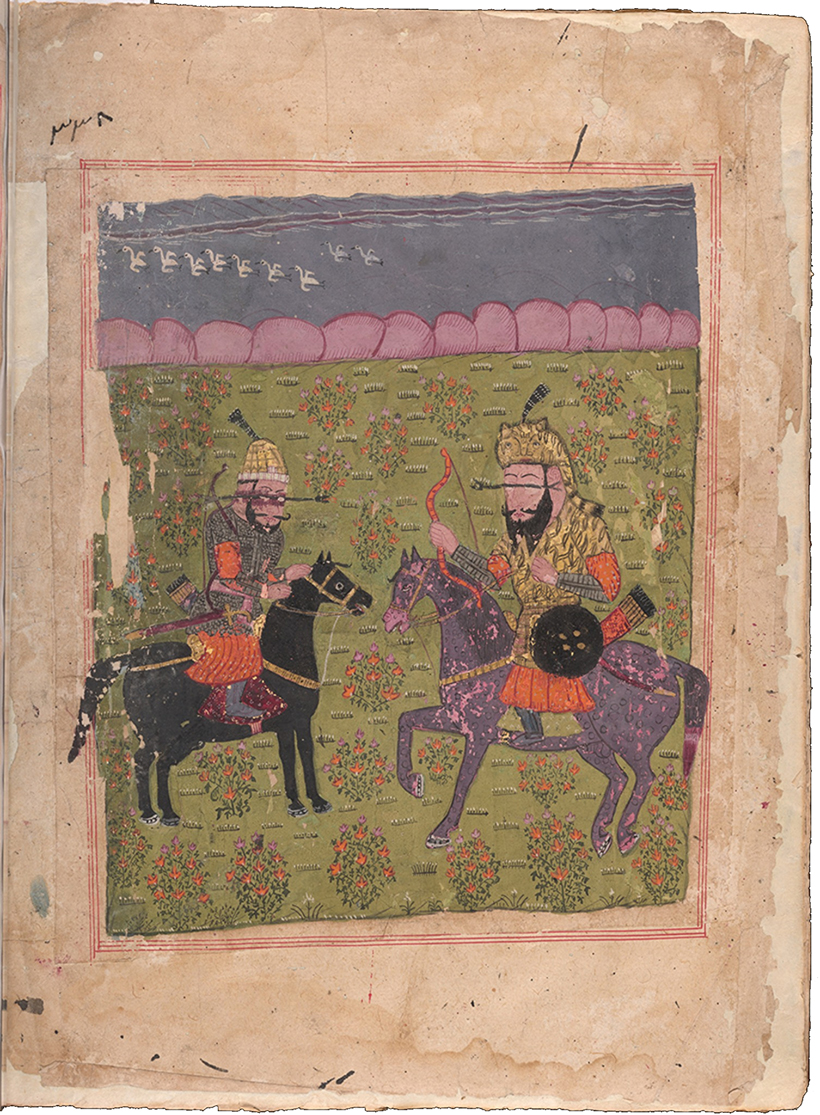
The physical sight that the White Demon’s blood grants Kay Kavus brings spiritual insight only for a short period. Soon after the Mazandaren mishap, he is again tempted, this time by the devil disguised as a handsome courtier, to construct a flying machine meant to discover who controls the turning of the cosmos. In Kay Kavus’ ignorance, as Ferdowsi explains, “he did not know that the heavens are immeasurable, that the stars are many but God is one, and that all are powerless beneath his law.” Surrounded by the birds who hoist his throne skyward, the illustrator of this manuscript depicts Kay Kavus pointlessly shooting arrows at the sky, a visual representation of the ruler’s ridiculous desire to conquer the heavens themselves.
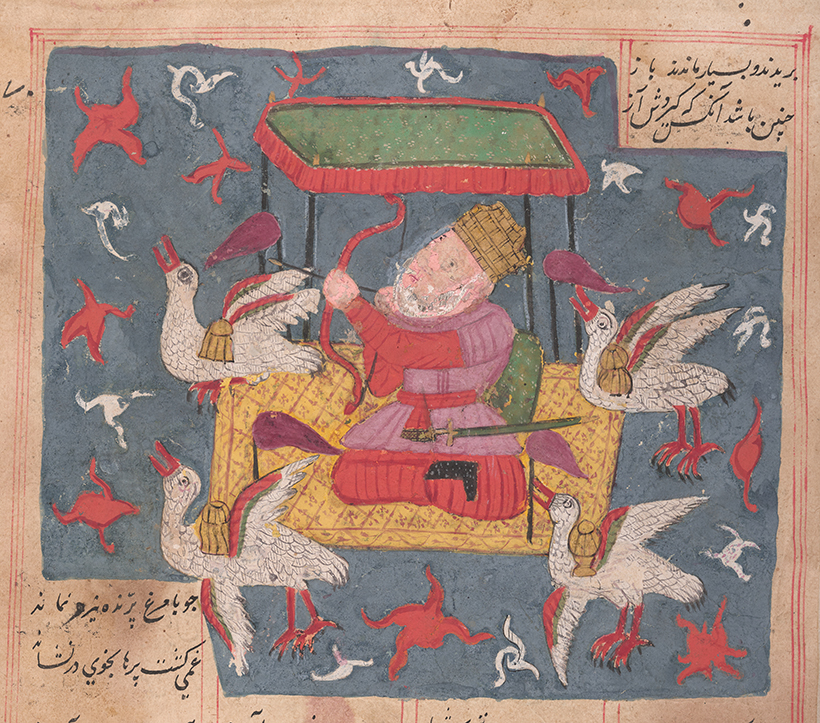 [f. 72 r – Kay Kavus’ throne takes flight]
As the birds’ strength gives out, and Kay Kavus tumbles back down to earth, Ferdowsi’s readers—whether in eleventh-century Isfahan or nineteenth-century Kashmir—are given an opportunity to meditate on the importance of seeing, perceiving, and reflecting on past errors, good advice, and, most importantly, the limits of man.